A Writing Corner That Packs Away Before Dinner
Build a temporary writing setup around the space you have, the light you can use and the amount of gear you actually need. A few sensible choices make it ready for a page—and simple to clear away.
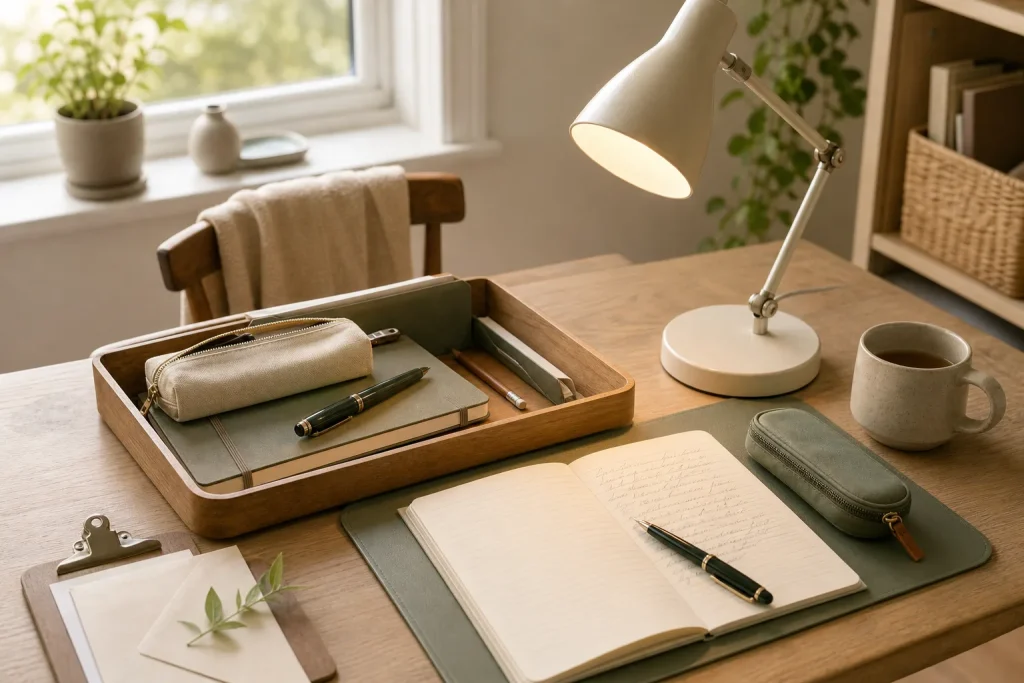
A writing corner can begin with a place mat, a pen case and one clear patch of table. The trick is to arrange the setup around how you will use it, then give every item a home for the moment the table needs to become a table again.
The right arrangement depends less on having a dedicated desk than on what gets in your way: shared space, poor light, scattered supplies or a routine that needs a gentle prompt. Choose the situation that sounds most like yours, and build from there.
Choose a tray when the table is shared
If your writing spot is also where someone eats, works or does homework, make the whole setup movable in one lift. A shallow wooden tray, a sturdy cafeteria tray or a lidded stationery box can hold a notebook, pen and a small handful of useful extras without claiming the surface all day.
Keep the tray compact enough to sit beside your chair rather than spread across the table. A notebook can rest underneath a pen case, with loose sheets in a slim folder. Leave out the decorative extras unless they have a clear use; a crowded tray is awkward to move and easier to spill.
Imagine you have a clear place at the end of the kitchen table but need it for dinner later. You set a tray there with your journal, one favourite pen, a pencil and an eraser. When you finish, the loose page goes back into the journal, the tools return to their case, and the tray moves to a nearby shelf.
Put the tray where it can be reached without lifting a stack of unrelated things first.
Use a portable light when the room changes
If your available chair moves from room to room, or daylight shifts while you write, make light part of the kit. A rechargeable desk lamp with a stable base suits a surface where a small pool of light is welcome. A clip-on lamp is better if the table edge is clear and you need to save space, though it may not fit every surface.
Before settling on a lamp, check the direction of the light and the route of its cord. Aim the beam so your hand does not cast a heavy shadow over the line you are writing. If you use a wired lamp, keep the lead away from walkways and from the edge where it could catch on a sleeve or bag.
For a setup that packs away, choose a lamp that can sit beside the paper without crowding it and can be carried safely once cool. If charging it is part of the routine, return it to the same charging spot after writing rather than leaving it wherever the session ended.
Set the lamp before opening the notebook; shifting it halfway through can nudge pens and paper out of place.
Keep only a working set when supplies wander
If pens and paper tend to migrate around the house, a small, dedicated kit can make starting less fiddly. Choose one notebook or writing pad, one dependable pen, and only the tools you reach for often, such as a pencil, eraser or ruler. A zip case or pencil pouch keeps them together; a paper folder protects loose sheets from bent corners.
Keep refills and rarely used stationery elsewhere. The portable kit is for the next writing session, not a travelling stationery cupboard. If you use different pens for different jobs, include the one suited to the paper you plan to use and store the rest in their usual place.
Say you write a few lines beside the living-room window and use a pencil to plan before writing in ink. Put a notebook, pencil, eraser and chosen pen in the same case-and-folder arrangement each time. The expected result is straightforward: when you open the kit, the page and tools for that session are already together.
When a tool runs out or feels uncomfortable, swap it deliberately rather than adding a second version “just in case”.
Give loose paper a boundary when the surface is busy
If your table holds mail, charging leads or other household items, a writing mat can mark out a clean, temporary zone. A smooth desk mat or firm document board gives paper a stable surface and can be lifted away with the page still on top. Choose a material that is easy to wipe and does not snag the paper edge.
For loose notes, use a folder with a pocket or a simple clip board. Keep active pages together, and move finished pages into a notebook or file before clearing the spot. That small sorting decision prevents scraps from disappearing beneath the next stack of post.
A writing mat is not a substitute for a clear patch of table: it needs room to sit flat, and the page should not hang over the edge where it can catch. If the surface is too crowded to lay it down, clear one small area first or choose a tray that can move elsewhere.
Keep the page inside the mat’s working area, with the pen case beside it rather than on top of it.
Make the smallest setup when time is brief
If you write in short gaps, a minimal arrangement is more useful than a carefully styled one. Leave the notebook and pen together in a drawer or on a shelf near the place you tend to sit. Add a bookmark or sticky tab if it helps you find the next blank page quickly.
Skip extra stationery unless your writing needs it. A single pen and a notebook that opens comfortably can be enough for a brief note or a journal entry. If the spot has poor light, move nearer a window when possible or bring over a small lamp; do not let a handsome but dim corner make the page tiring to read.
Decide what counts as “ready” before you put the kit away. For one person, that may mean the notebook is open to a blank page; for another, it means the pen is capped and stored beside it. Either arrangement works if it makes the next start easier and still clears the shared surface.
Finish with a repeatable clearing routine
A temporary corner stays easy to use when packing away takes a few clear actions. Close the notebook, return pens to their case, collect loose pages, switch off the lamp and carry the kit to its home. If you use a tray or mat, check that no small item has slipped underneath before putting it away.
Keep the storage place close to the writing spot if you can. A shelf, drawer or basket within easy reach is more useful than a carefully chosen box at the far end of the house. Store the lamp where it can be charged or its lead can be wound loosely without bending or pinching it.
Finally, leave the surface ready for its next job: move crumbs or scraps, return household items to their places and make sure the chair can be used as intended. A writing corner does not need to stay visible to be welcoming. It only needs a clear starting point, tools that suit the page, and a reliable way back into storage.