The Journal with No Catch-Up Rule
A journal can pause without turning into an overdue assignment. Follow one invented writer as she builds a simple format that makes returning easy.
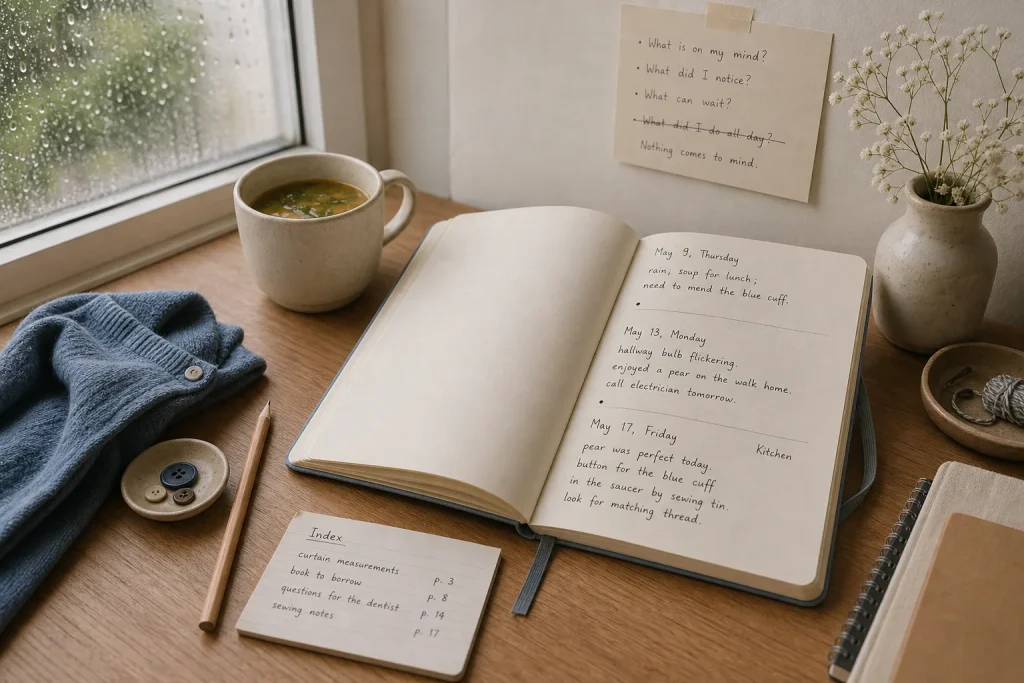
Mara opens her journal on a rainy Thursday, finds the last entry dated three weeks ago, and nearly closes it again. The blank pages seem to ask where she has been. Instead of explaining the gap, she writes “Thursday, rain; soup for lunch; need to mend the blue cuff” and leaves the rest of the page empty.
Imagine Mara as an invented writer, not a real case: she wants a place to notice small things and untangle the occasional worry, but daily entries have begun to feel like homework. Her new rule is plain: a journal entry starts whenever she writes, not whenever the calendar says she should.
Make the return smaller than the gap
Mara’s old format had a dated page for every day. Missing one felt manageable; missing several made the notebook resemble a row of unanswered questions. She decided not to fill those pages or summarise the weeks she had skipped.
On the first page after the gap, she writes the date, then one observation and one task. The entry is brief, but it gives her a point of contact with the present. She can add more if she wants; she does not have to earn the right to write by accounting for the days before.
That choice matters because catch-up work grows quickly. A writer may feel compelled to reconstruct meals, moods, errands and conversations, even when the details have blurred. A no-catch-up rule lets the journal hold what is available now rather than demand an imperfect archive of everything that came before.
Leave the missed days blank. They are not a debt.
Give each entry a clear landing place
Mara changes the page layout to suit an irregular rhythm. She writes the date at the top of each entry and leaves a little breathing room before the next one. If she has only a sentence, it gets a line; if she has a longer thought, it can continue below without needing a pre-printed box.
She keeps the format deliberately familiar: date, a small note about the day, then whatever needs space. A simple pencil line or a small dot can separate entries if they share a page. There is no need to reserve a page for each date, draw a calendar, or maintain a numbered sequence.
On a crowded page, Mara adds a small heading such as “Kitchen” or “Call with Jo” so she can find the thought later. Headings are navigation, not decoration she must apply to every entry. The point is to make the next blank patch usable, even if the notebook has been shut for a while.
Use a prompt that does not demand a full story
When Mara feels unsure what to write, she avoids prompts that ask for a complete review of the day. Instead, she keeps a few small openings on the inside cover: “What is on my mind?”, “What did I notice?”, and “What can wait?” Each can be answered in a phrase, a list or a longer passage.
One evening, she writes that the hallway bulb is flickering, that she enjoyed a pear on the walk home, and that she can call the electrician tomorrow. The details are ordinary, but they give the page texture: a place, a taste, and a next action. She does not turn them into a polished account.
A prompt should reduce the effort of starting, not create another standard to meet. If a question feels stale, Mara crosses it out and chooses another. She can also write “Nothing comes to mind” and stop there; a journal is allowed to contain an unfinished thought.
Separate useful notes from a demand for continuity
After a few entries, Mara notices that some pages contain practical details she may want to find again. She adds a modest index at the front, with a topic and page number only when it would genuinely help: “curtain measurements,” “book to borrow,” or “questions for the dentist.” She does not index every entry or turn the notebook into a filing system.
This distinction keeps the journal from becoming a streak-tracking exercise. Dates help her orient herself; they do not have to prove regularity. A missed stretch remains visible as a gap in the sequence, but it carries no judgement and needs no explanatory note.
For a writer who prefers a bit more structure, a loose weekly page can offer room for a few entries without assigning one box to each day. Leave a margin for a short list, or mark the next entry with a date and a small symbol. Choose a format that makes finding things easier, then let the rest stay flexible.
Let the format change when it stops helping
Mara’s first attempt is not perfect for her. She initially writes on the right-hand page only, hoping to keep entries visually separate, but soon dislikes seeing a half-empty spread. She switches to using whichever page is open and places a small divider between entries when she wants one.
That adjustment is part of the method, not a failure of discipline. Paper invites revision: a sticky tab can mark an index, a ruler can make a divider, and a pencil can test a heading before ink makes it permanent. But the notebook does not need a redesign every time a habit changes.
She keeps one steady convention—the date at the start—and lets the rest vary. On some days she writes a paragraph; on others, a short list or a single line. A form can be recognisable without being rigid.
Notice what changes when returning is easy
In this invented situation, Mara’s result is not a flawless run of daily entries. It is a notebook she can reopen without first doing repair work. A few weeks later, she writes about the blue cuff she meant to mend, adds that the button is now in a saucer by the sewing tin, and makes a note to look for matching thread.
The detail connects two moments without requiring a summary of everything between them. That is enough continuity for the purpose she chose: keeping thoughts, small observations and loose ends in one place. If she leaves another gap, the next page will still be available.
To make the approach your own, choose a single returning convention—perhaps the date, a recurring prompt, or a small divider—and keep it easy to use. When you open the notebook after a pause, write what is present, not what you think you owe the blank pages.