The Notebook Opens Flat, but Does the Paper Suit Your Pen?
A notebook can lie beautifully open and still frustrate your favourite pen. Check show-through, feathering and drying separately before deciding whether its paper works for your writing.
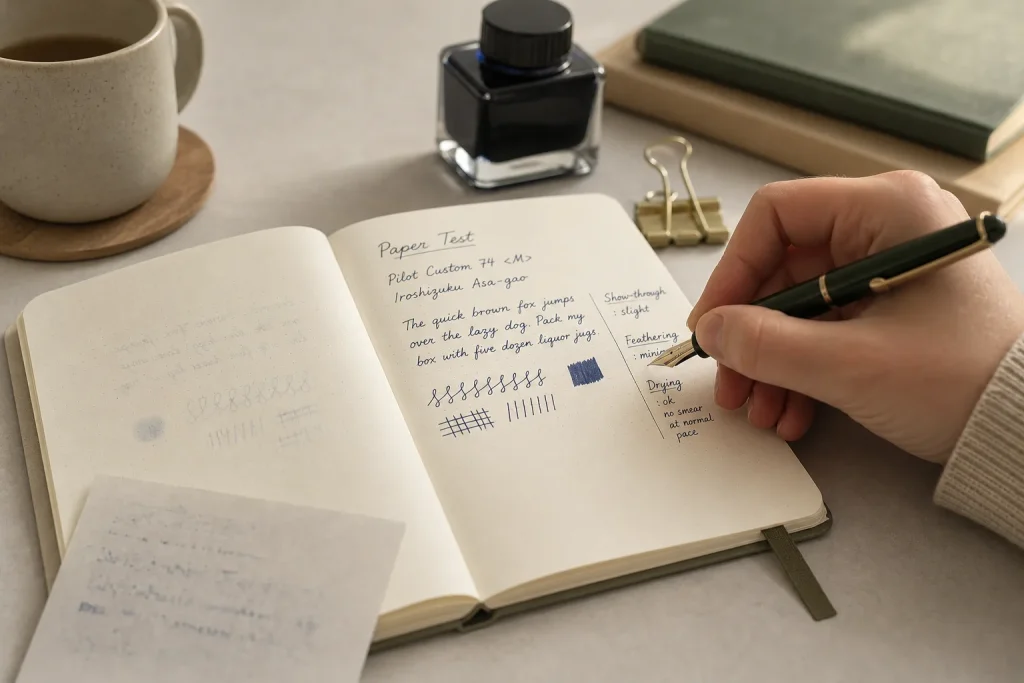
A notebook can lie flat on the desk and still turn a satisfying pen into a nuisance: ink may spread along the fibres, mark the page beneath, or stay wet long enough to catch your hand. Assess those behaviours separately, using the pen and ink you actually plan to use. A quick, orderly trial tells you more than the paper’s smooth feel or a label on the cover.
Choose the pen and page you want to judge
Start with the combination that matters. If you usually write with a gel pen, test that gel pen; if you reach for a fountain pen, use its usual ink and nib. Paper can respond differently to different inks, so a result from one pen does not automatically transfer to another.
Pick a page near the middle of the notebook, where the paper is likely to represent the rest of the book, and slide a spare sheet beneath it. This protects the following page and gives you a clear view of any ink that gets through. Use a light-coloured page if possible, since marks are easier to inspect.
Keep the pen’s ink supply and writing pressure ordinary. A test made by pressing unusually hard or laying down an oversized pool of ink tells you little about the way you normally write.
Make a small, repeatable test
Write a few lines in your usual hand, then add a short heading, a loop or two, and a couple of strokes where you pause briefly. Include ordinary letters with tight turns, such as e, a or g. Those turns can reveal spreading that a long straight line might conceal.
Leave space beside the writing for a swatch or a few extra strokes. Keep the test compact, but make sure it includes both your normal pace and a slower movement that leaves ink on the page for longer. Do not judge the paper until you have looked at the front and the sheet beneath.
Say you buy a notebook for evening notes written with a fountain pen. You make a short paragraph, a heading and a few slow loops on a middle page, then inspect the reverse and check for smudging at your usual writing pace. The separate observations help you decide whether the notebook suits those notes, rather than whether it seems good in the abstract.
Check show-through without confusing it with bleed-through
Turn the page over and look for two different things. Show-through is ink visible from the other side of the sheet; the paper remains intact, but writing on the reverse may feel visually crowded. Bleed-through is ink that has passed through the paper and left a mark on the sheet underneath.
Hold the page over a bright surface if faint show-through is hard to see. Then inspect the protected sheet beneath for spots or lines. A dark line visible through the page is not, by itself, proof of bleed-through, so check the paper surface before deciding.
Ask what you need from the notebook. If you write on both sides, even noticeable show-through may make a page feel busy. If you use only one side, it may matter less, provided ink has not bled through and the reverse remains usable.
Look at the page beneath the test before ruling the notebook in or out.
Look for feathering at the edges
Feathering appears when ink spreads outward from a stroke into small, irregular threads. Inspect the edges of your letters and loops closely; a line can look wider or fuzzy without producing obvious marks on the reverse. That is a different problem from show-through, which is about visibility through the sheet.
Compare similar strokes across the test rather than relying on one dark patch. If fine letter shapes stay distinct and their edges look clean, the paper is controlling that ink well enough for your style. If letters lose their shape, consider a different notebook or a pen-and-ink combination that leaves a drier, more contained line.
Pay particular attention to places where your pen pauses or turns. Those spots collect more ink during ordinary writing and can reveal feathering sooner than a quick, straight stroke.
Judge drying time with your own writing hand
Drying behaviour is its own trade-off. Ink that remains wet may smear beneath your hand or transfer when the page is turned; a very quick-drying surface can be convenient, though the line may feel different under the pen. Check the result at the pace you normally write instead of assuming every ink dries alike.
Write a fresh line, then make your usual hand movement across the page without deliberately touching the wet strokes. If you are left-handed, use the position and movement you naturally use; if you write from above, test that too. Look for a smudge on the page and on the side of your hand.
You can also touch the edge of a fresh stroke lightly with a clean fingertip or scrap paper after a brief pause. Keep the check gentle, and use a new part of the scrap so you can see whether ink transfers. The useful answer is not an abstract drying speed but whether the ink is ready before your hand or the next page reaches it.
Decide which compromise suits the notebook
Read your observations as separate answers: does the ink show through, does it feather, and does it stay wet too long for your writing habits? One weakness need not outweigh the others. A page that shows faintly through may still work for one-sided notes, while crisp lines are little comfort if your hand smears them as you write.
Repeat the same compact test with another notebook or a different pen-and-ink pairing if the first result is borderline. Change one thing at a time so you can tell what made the difference. If you do not have the exact notebook in hand, try the same method on a sample page, then confirm on a middle page before committing to the book.
Keep the test page as a reference if you own several notebooks. A brief note beside it—naming the pen and ink, and recording show-through, feathering and smudging—can help you choose the right paper for the next writing session.